


Search is changing fast. If you work in digital marketing, blogging, eCommerce, or even if you just use Google daily, you have probably noticed something different. Search results are becoming smarter, more direct, and more personalized. This shift is largely driven by Google AI mode and the wider use of AI on search engine systems.
In this blog, we will clearly explain what Google AI mode is, how it affects Search engine optimization (SEO), and what you should do to stay ahead. I will also share some important facts and data from the digital marketing industry and answer common questions people ask.
Let’s start from the basics.
What is Google AI mode?
Google AI mode refers to the AI-powered search experience introduced by Google, where artificial intelligence generates answers directly in search results instead of only showing links.
This includes features like:
- AI-generated summaries at the top of search results
- Context-based answers
- Conversational-style responses
- More personalized search suggestions
Instead of just giving you 10 blue links, Google now tries to understand your intent and provide a direct answer using AI models.
This system is powered by advanced AI models like Google Gemini, which help Google understand language, context, and user intent better than ever before.
Simple Example:
Before:
You searched “Best protein for beginners” → You got blog links.
Now:
You search the same → You may get an AI summary explaining types of protein, who should use them, and what to consider.
That is Google AI mode in action.
Why is Google Using AI on Search Engines?
Google handles over 8.5 billion searches per day globally. According to industry data, more than 90% of global search traffic goes through Google.
Users today want:
- Faster answers
- Clear explanations
- No need to open multiple pages
- Personalized results
AI helps Google:
- Understand complex queries
- Reduce misinformation
- Improve search quality
- Compete with AI chat tools
From a business point of view, Google must keep users on its platform longer. AI summaries help achieve that.
How Does Google AI Mode Impact Search Engine Optimization?
This is the most important part for marketers and website owners.
1. Reduced Click-Through Rates (CTR)
If AI gives answers directly on the results page, fewer users may click on websites.
Some early digital marketing reports suggest that AI-generated summaries can reduce organic CTR by 15% to 30% for certain informational queries.
That means:
Even if you rank #1, you may get fewer clicks.
2. Content Quality Matters More Than Ever
Google AI mode does not just look for keywords. It looks for:
- Expertise
- Clear structure
- Real value
- Accurate data
- Trust signals
This means basic keyword stuffing is no longer effective.
Search engine optimization is now about:
- Answering real questions
- Covering topics deeply
- Using structured headings
- Adding real data and facts
3. Authority and Brand Recognition Become Important
AI systems prefer:
- Trusted websites
- Recognized brands
- Expert-written content
If your brand is mentioned across multiple reliable platforms, your chances of being referenced in AI-generated summaries increase.
Big Question: Is SEO Dead Because of Google AI Mode?
No. SEO is not dead.
It is changing.
In fact:
- The global SEO industry is worth over $80 billion.
- Digital advertising spending worldwide crossed $600 billion recently.
- Over 60% of marketers say SEO generates higher quality leads than paid ads.
What is changing is the strategy.
How to Adapt Your SEO Strategy for Google AI Mode
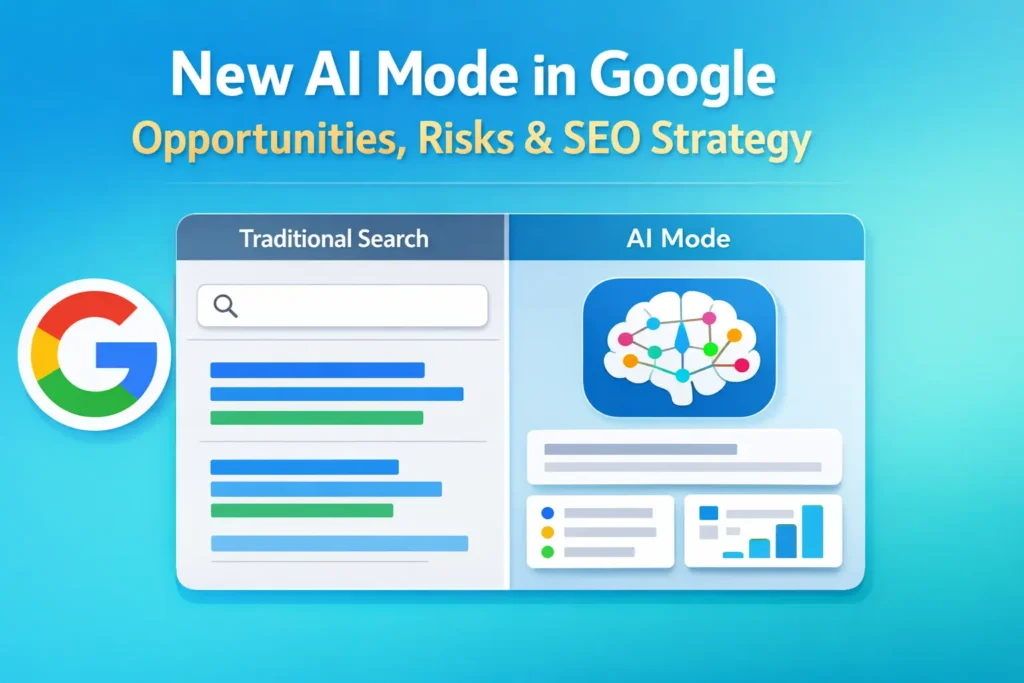
Here are practical solutions you can apply:
1. Focus on Search Intent
Ask yourself:
- What problem is the user trying to solve?
- What exact answer are they looking for?
Write content that clearly answers these questions.
2. Use Question-Based Content
Since AI on search engine systems focus on questions, include:
- What is…
- How does…
- Why is…
- Is it safe to…
Create FAQ sections in your blogs.
3. Add Data, Facts, and Examples
AI prefers content with:
- Statistics
- Real case studies
- Industry numbers
For example:
Instead of saying “SEO is important,” say:
“Over 53% of website traffic comes from organic search.”
That builds authority.
4. Improve Technical SEO
Even in Google AI mode, technical SEO still matters:
- Fast website speed
- Mobile-friendly design
- Structured data
- Clean internal linking
Google’s systems still crawl and index your pages.
5. Build Topical Authority
Instead of writing random blogs, focus on one niche.
Example:
If your niche is digital marketing:
Write 20–30 detailed blogs covering SEO, paid ads, AI tools, analytics, content strategy, etc.
That signals expertise.
How Do I Turn On Google AI Mode?
Many users ask this question.
The truth is:
In most regions, Google AI mode is automatically integrated into search results. You do not need to manually turn it on.
However:
- Make sure you are logged into your Google account.
- Update your Google app (if using mobile).
- Some AI features may be rolled out gradually depending on country.
Google controls availability based on region and testing phases.
Expert Questions You Should Be Asking
As a content writer and digital marketing expert, I would ask you:
- If AI gives answers directly, why should users visit your website?
- Is your content better than what AI can summarize?
- Are you building brand trust or just chasing keywords?
- Are you optimizing for humans first, or only algorithms?
- What unique value does your content provide?
These are important questions in the era of Google AI mode.
The Future of AI on Search Engine

AI will not replace websites completely.
Instead, search will likely become:
- More conversational
- More visual
- More personalized
- More voice-driven
According to industry trends:
- Over 50% of younger users prefer conversational AI-style search experiences.
- Voice search usage continues to grow year by year.
Businesses that adapt early will benefit.
FAQs
1. What is Google AI mode?
Google AI mode is an AI-powered search experience where Google generates direct answers and summaries using artificial intelligence instead of only showing website links.
2. How do I turn on Google AI mode?
In most cases, you do not need to turn it on manually. It is automatically enabled in supported regions. Just update your Google app or browser and log in to your account.
3. Does Google AI mode affect SEO?
Yes. It can reduce click-through rates for some keywords. However, high-quality and authoritative content still performs well.
4. Is SEO still worth investing in?
Yes. SEO remains one of the highest ROI digital marketing strategies. The strategy just needs to evolve with AI-driven search.
5. How can small businesses survive in AI-driven search?
By:
- Focusing on niche topics
- Building authority
- Creating helpful content
- Using structured data
- Improving website experience
Final Advice for Content Creators and Businesses
Here is my honest advice:
Do not fear Google AI mode. Understand it.
Instead of trying to “beat” AI:
- Work with it.
- Create content that AI wants to reference.
- Focus on solving real user problems.
Remember:
Google’s goal is to help users. If your content genuinely helps users, it will always have value.
In this new world of AI on search engine systems, the winners will be those who:
- Think long-term
- Focus on trust
- Provide real knowledge
- Adapt quickly
SEO is not ending. It is maturing.
The question is not:
“Will AI replace search?”
The real question is:
“Are you ready to evolve with it?”